
Honey bee removal in Atlanta · UGA Journeyman
Live Removal, and Without Chemicals
We’re licensed, insured, and certified in honey bee removal. We remove the honey bee colony and all the comb without chemicals, fill the empty void with insulation, and re-home the colony in a local beekeeper’s apiary.
Get the Bees Out, and the Wall Sealed
Reply in 1–2 business days · No chemicals · One-year guarantee
Why it matters
Extermination Leaves the Hard Part Behind
-
No Chemicals, Ever
We get into the wall and remove honey bees without spraying anything. The colony is relocated quickly and with minimal stress to a managed hive on our homestead.
-
All the Comb Comes Out
Abandoned honeycomb draws ants, roaches, rodents, hive beetles, and wax moths. We take out the entire comb structure so you don’t trade one pest for another.
-
Insulated and Sealed
We fill the empty cavity with insulation and close every entrance, then back it with a one-year guarantee that bees won’t rebuild in the same spot.
The process
How a Structural Removal Works
Every property is different, but a cut-out follows the same five stages.
-
Confirm & Quote
We verify they’re honey bees, locate the colony, and give you an estimate.
-
Open the Void
We get into the wall, soffit, or siding through the smallest access the job allows.
-
Remove Bees & Comb
Every bee, all the brood, and the full comb structure come out — queen included.
-
Insulate the Cavity
The empty void gets packed with insulation so it’s no longer an attractive home.
-
Seal & Guarantee
Entry points are closed up, covered by our one-year removal guarantee.
Where we find them
Bees in a Wall, Soffit, or Siding
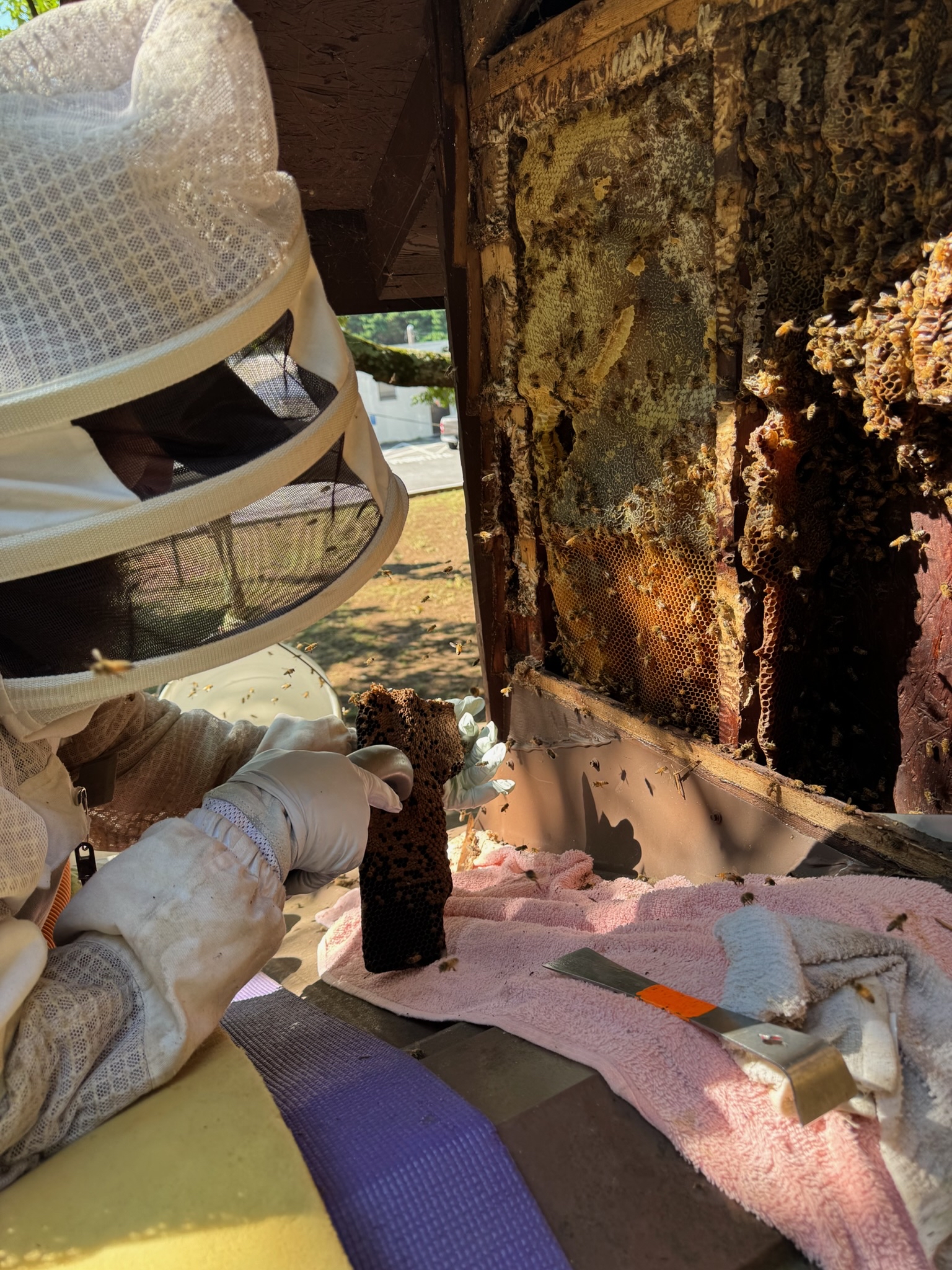
Honey bees move into any protected cavity they can reach through a gap the width of a pencil. Around metro Atlanta we most often pull colonies out of exterior walls, soffits and eaves, chimney chases, deck boxes, sheds, and vinyl siding.
We have the equipment and the knowledge to reach the colony while keeping structural damage to a minimum during the removal.
- Residential homes and additions
- Commercial buildings
- Garages, sheds, and outbuildings
- Siding, soffits, eaves, and chimney chases
Before you call anyone
Know What You’re Looking At
Half the calls we get turn out to be something other than a honey bee colony. Here’s how to tell, and it’ll save you a service fee either way.
Honey Bees
This is our call
- Golden brown and black bands, fuzzy body
- Roughly the size of a pencil eraser
- Steady two-way traffic at one small opening
- Working flowers, legs often loaded with pollen
- Not interested in your food or drinks
Wasps, Hornets & Yellow Jackets
Call a pest company instead
- Smooth, shiny, narrow waist with no fuzz
- Bright yellow or gray papery nest
- Aggressive when approached, can sting repeatedly
- Drawn to meat, soda, and trash cans
- We’re certified for honey bees only, so we don’t take these
A Swarm
Usually free to collect
- A hanging cluster out in the open
- On a branch, fence post, mailbox, or shrub
- Arrived suddenly, often within the hour
- Gentle, no brood or honey to defend
- Will move on within a day or two, so call quickly
An Established Colony
Needs a full removal
- Bees flying in and out of a hole in a structure
- Same entrance every day for weeks
- Sometimes a faint hum through the drywall
- There’s comb inside the wall you can’t see
- Requires opening the void, not a swarm catch
The Beekeeping Year in Georgia
Swarm season: when clusters show up
March through June.
Inspection & mentorship season
March through August.
Swarm season peaks in spring, when colonies build up fast on the early nectar flow. If you see a cluster of honey bees between March and June, give us a call to inspect.
Who you’re calling
A Family Homestead, Not a Call Center
We’re a small family operation in Marietta. The person who quotes your job is the same person who does the work, and who keeps the bees afterward.
-
UGA Journeyman Beekeeper
Certified through the University of Georgia Master Beekeeper Program at the Journeyman level, and currently working toward the Master Beekeeper level.
-
Honey Bees Only
We’re certified in removal for honey bees, and honey bees are all we take. Wasps, hornets, and yellow jackets are a different call.
-
State-Inspected Apiary
Our hives are inspected and registered with the Georgia Department of Agriculture. The bees we remove and the bees we sell live in the same yard.
FAQ
Common Questions on Bee Removal
It depends on how the colony is accessed, a ground-level soffit is a very different job from a second-story wall. We quote after we see it, and the estimate is free.
No. We remove honey bees without chemicals and relocate the colony to our homestead. That's the whole reason to call a beekeeper instead of an exterminator.
We fill the cavity with insulation and seal every entry point, and we put things back as neatly as we can. But we're beekeepers, not contractors, we don't do finish carpentry, siding replacement, or paint matching. Plan on a contractor for cosmetic work.
Our one-year removal guarantee covers it. Because we insulate and seal every entrance to the void, we're confident a new colony won't rebuild in that same spot, and if one does within the year, we come back.
No. We're certified in removal for honey bees only, and honey bees are all we handle. If you send a photo we'll tell you what you've got and point you toward the right person.
Text us a photo, and a short video if you can get one safely. Honey bees are what we do, so we'd rather tell you up front than have you pay for the wrong visit.
Have honey bees in your home?
Contact us for more information and an estimate. Most metro Atlanta calls get a same-week response.